UAE VAT - 5-year credit expiry
Your clients' 2018-2021 VAT credits expire on 31 December.
Refund balances sitting at the FTA are forfeited permanently unless a VAT311 refund application is filed in time. We build the evidence packs white-label, at a fixed price, in five business days - your firm reviews, signs, files, and bills the recovery.
The mechanic
Found money, with a hard date.
Businesses whose input VAT exceeded their output VAT have carried credit balances at the FTA for years, and most never filed to get the money back. The law changed.
Credits now expire
Federal Decree-Laws 16 and 17 of 2025 (effective 1 January 2026) cap credit carry-forward at five years from the period the credit arose.
One transitional window
Credits from 2018-2021 whose five-year window has already expired, or expires during 2026, get one grace period: a refund application filed by 31 December 2026 - or the balance is forfeited.
Only the filing must be in
The deadline applies to the application, not the payout. The FTA's standard review is 20 business days - but December filings leave no room for queries. The clock favours firms that move now.
Basis: Art. 74(3) VAT law as amended by FDL 16/2025; Art. 38 and transitional Art. 3, FDL 17/2025. Citation appendix included in every pack.
The deliverable
A review-ready evidence pack, under your brand.
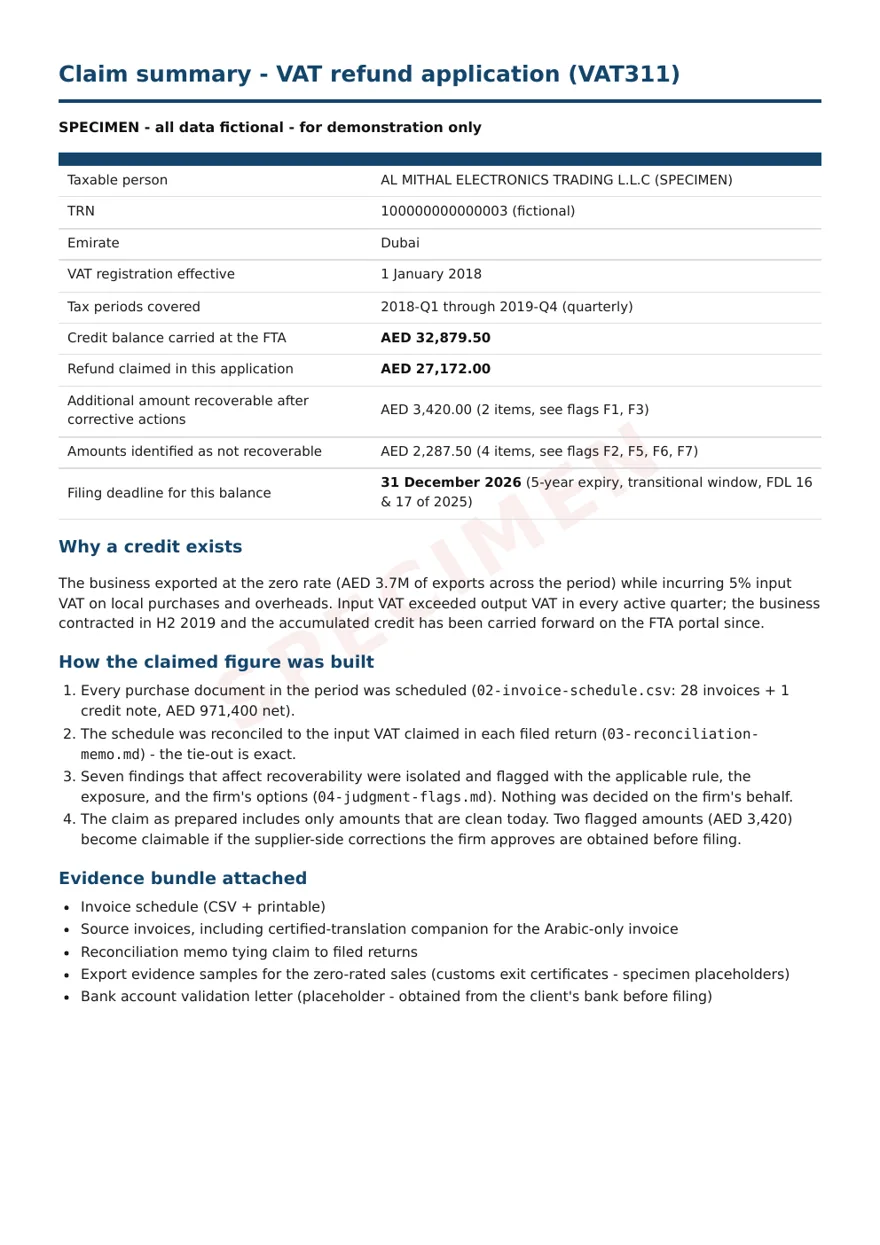
- Claim summaryEntity, periods, balance derivation, claimed amount - one page your reviewer starts from.
- Invoice scheduleEvery source document scheduled: supplier, TRN, dates, amounts, status - including Arabic-language invoices, with working translations.
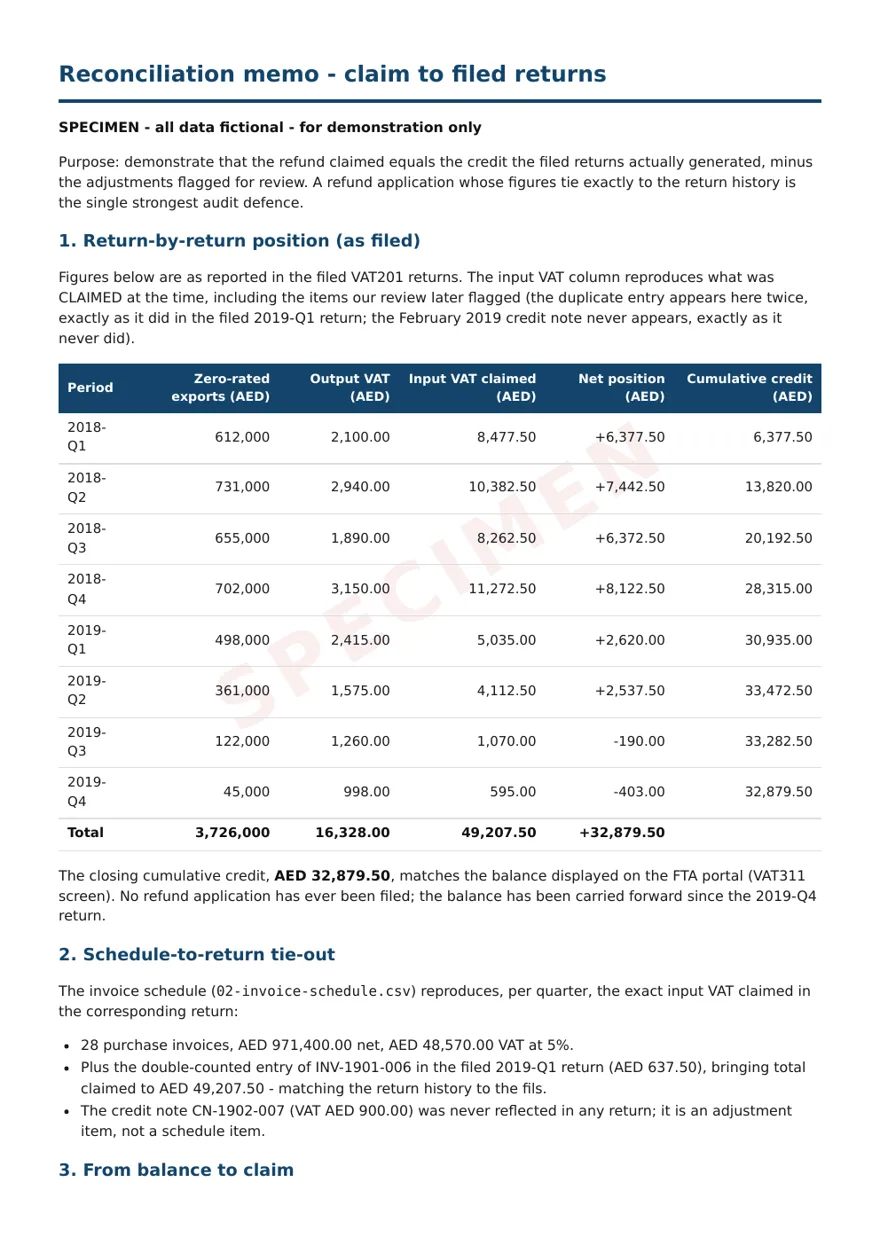
- Reconciliation memoThe claim tied to the filed returns, period by period, exact to the fils. The strongest audit defence a refund file can carry.
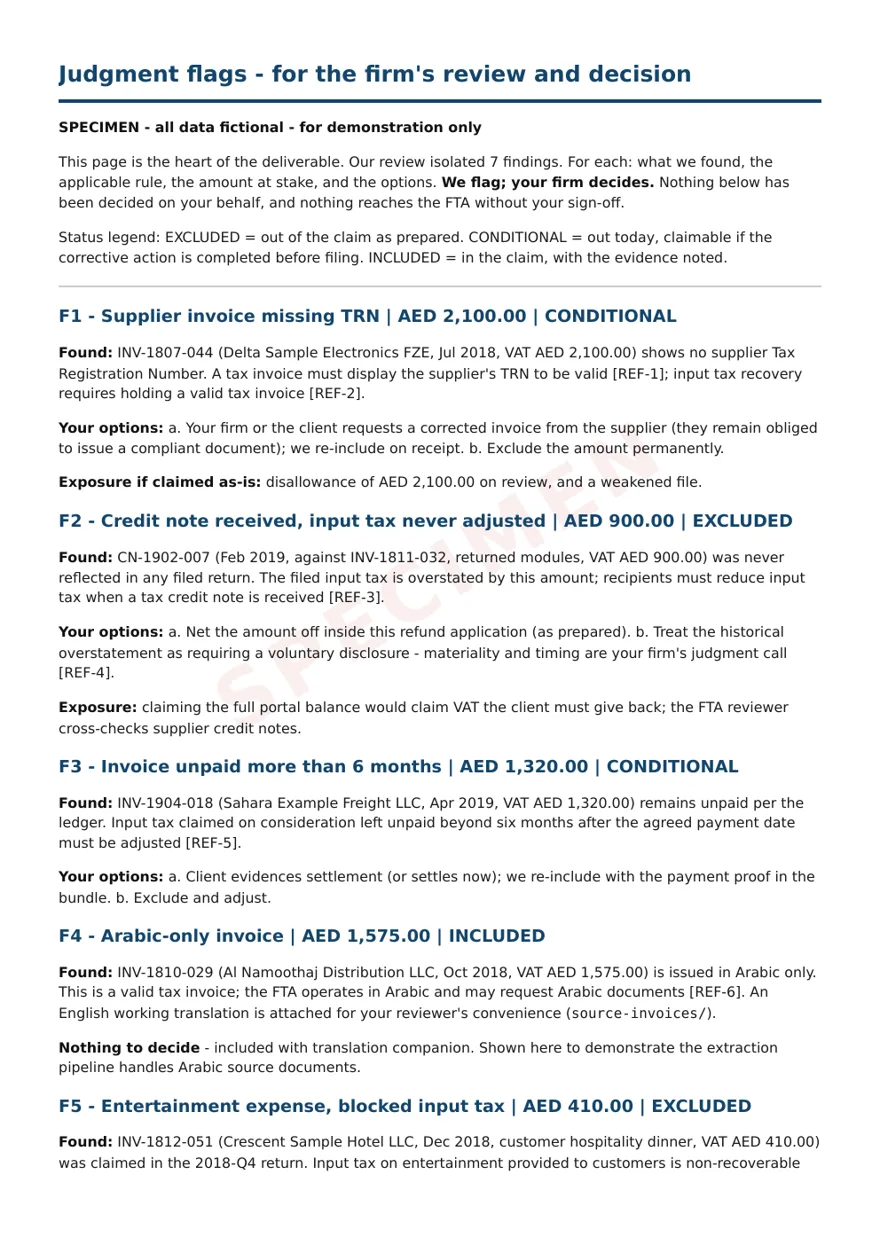
- Judgment flagsEvery point that needs professional judgment - isolated, cited to the rule, quantified, framed as options. We flag; your firm decides.
- Filing checklistWhat remains for your firm: roughly 45 minutes of review and decisions, then filing from the client's own EmaraTax account under your supervision.
Credit note received, input tax never adjusted - AED 900.00
CN-1902-007 (Feb 2019) was never reflected in any filed return; the balance is overstated by this amount. Recipients must reduce input tax in the period a tax credit note is received (Art. 63(2), VAT Decree-Law).
Every flag reads like this: finding, rule, exposure, your options.
Inside the specimen pack
Judge the work before we ever talk.
Four pages from the anonymized specimen pack - fictional data, real structure. The full pack is one email away.

Where the balances sit
Which of your clients is holding one.
A credit balance forms one way only: input VAT ran ahead of output VAT, year after year, and nobody filed to get it back. In an SME portfolio it clusters in a few recognisable shapes. The specimen above is the first of them.
The exporter
Buys locally at 5%, invoices abroad at 0%. Electronics, auto parts, machinery, textiles, general trading: the re-export business Dubai runs on. The largest and most common balances.
The build year
A fit-out, a plant, a warehouse, a clinic. One year of heavy capitalised spend against little revenue, and a credit that was never worked off once the revenue which followed disappointed.
The developer
Construction inputs carrying 5% across years, against a first supply of the finished residential building at 0%. The inputs run long before that first supply, so the balance builds across many periods.
Investment metals
Supplies of investment precious metals are zero-rated while every cost around them still carries 5%: the Dubai gold and bullion trade, where the balance accumulates on overheads and services.
Not every balance is a claim. Some are artifacts of an old filing error, a credit note received and never adjusted, and belong in a voluntary disclosure rather than a refund application. The pack tells you which one you are holding before anything is filed. And a client making only exempt supplies never built a credit at all: its input tax was not recoverable in the first place.
Zero-rating basis: Art. 45(1) exports, 45(8) investment precious metals, 45(9) first supply of residential buildings within three years of completion, VAT Decree-Law 8/2017 as amended. Exempt supplies (Art. 46) build no recoverable credit.
How it works
Three steps. Zero process change for your firm.
Send the records
Ledger export and invoice files, through your systems or a shared drive. NDA first; access ends at delivery.
Five business days
Extraction, matching, reconciliation and flagging - automated pipeline with human quality control.
Review, sign, file, bill
Your firm decides every flagged point, signs, files, and bills its client for the recovery work.
Pricing
Fixed prices. No retainers, no minimums.
| Pack | Scope | Price |
|---|---|---|
| Simple | Single period, under 50 invoices, clean recordsTypical small-balance claim | AED 1,500 |
| Standard | Multi-period reconciliation, under 200 invoicesThe common 2018-2021 archaeology case | AED 2,500 |
| Complex | Record reconstruction, export and customs evidenceZero-rated exporters, missing-records cases | AED 4,000 |
Rates for the 2026 transitional season.
You bill your client for the recovery engagement on top - the margin, and the client relationship, stay yours.
After December
The deadline is how we meet. It is not the product.
The same production model - review-ready packs, fixed price, your brand - continues past the transitional window:
Corporate tax return packs
Every filing season from 2027: per-return prep packs for your CT workload, priced per complexity, delivered review-ready.
Backlog and audit-response packs
Reconciliation cleanups and FTA query responses - the overflow work that eats partner hours in every busy month.
E-invoicing data work
As the UAE e-invoicing mandate phases in through 2027, client onboarding and data migration by the pack.
December-sprint partners get priority on 2027 capacity.